

Forget age and gender. In 2026, winning segmentation is driven by behavior, context, and identity. Here’s how our team applies this approach to create content that truly resonates and converts.
Experienced professionals, with robust budgets and seemingly well-designed strategies, still get stuck on a fundamental question: who, exactly, is this content for?
Amid the whirlwind of discussions about technical SEO, Artificial Intelligence, and new algorithms, we make the mistake of assuming that “target audience” is a solved concept. It is not. The way we define audiences in 2026 requires an urgent and deep revision.
The traditional model—based on static demographics such as age range, gender, and location—has become a crude and ineffective portrait. Knowing that content is aimed at “men, 30 to 45 years old, upper class, São Paulo” tells me almost nothing about that person’s life stage, specific professional challenge, or search intent.
This approach generates generic content that competes in the noisy field of superficiality. So what do we do to cut through that noise?
The forgotten pillar: behavior and intent as the new compass
When we shift the focus from the “person” to the “person’s behavior” within a given context, everything changes. Instead of creating content for “Carlos, 40, marketing manager,” we create it for “the professional who, at 9 p.m. on a Wednesday, searches YouTube for ‘how to justify increasing the SEO budget to the board.’”
The difference is enormous. The first is a vague function; the second is a human being with an urgent need, an emotional context (pressure, fatigue), and a clear intention (persuasion, internal education).
This requires active and qualified listening. I’m not talking only about analyzing keywords. I’m talking about diving into industry forums, restricted LinkedIn groups, comments in specialized newsletters, and even customer service transcripts (when possible and ethical).
The guiding question for content curation should be: “What is the unspoken pain behind this question?” A term like “best SEO tool” may actually hide an intention such as “I don’t want to waste time testing bad tools” or “I need an argument to discontinue an expensive contract.”
Context Marketing: relevance at the right moment
This is where Context Marketing stops being jargon and becomes a strategic lever. Relevant content fits perfectly into the moment, mindset, and scenario of your audience.
For an SEO-specialized agency, this means going beyond publishing an article about Core Web Vitals. It means, for example, creating a quick and actionable guide on “how to diagnose traffic drops after seasonal algorithm updates” precisely when those drops start being reported in forums.
The agility to read the context and respond with authority is what separates a useful resource from a forgettable article.
This requires editorial flexibility that rigid calendars often suffocate. We therefore reserve part of our production capacity for “opportunity content” that responds to emerging contexts. The credibility gained in these moments is exponentially greater than that generated by predictable, programmatic content.
Building identity, not just personas
Finally, the most advanced step we have implemented: Identity Marketing. If context addresses the “moment,” identity addresses the “belief system.” Instead of segmenting by job title, we segment by worldview and professional values.
We can identify, for example, the “trend-skeptical strategists,” the “technical early adopters,” or the “cost-benefit-oriented managers.” Each of these groups consumes information in radically different ways, trusts different sources, and responds to specific arguments.
Content for the “skeptical strategist” must necessarily address objections, cite case studies with strict controls, and avoid an overly enthusiastic tone. For the “technical early adopter,” we can dive deeper into nuances, edge experimentation, and well-grounded speculation about the future.
This layer of segmentation creates the powerful feeling in the reader that “this brand understands me.” It is the peak of personalization at scale.
Integrating the winning triad
In practice, the triad—Behavior/Intent, Context, and Identity—requires restructuring the portal’s content optimization process. The brief stops being a form and becomes a “Resonance Map,” built at the intersection of three sources: search data layered with intent, live insights from communities, and qualitative analysis of real conversations.
This map reveals not only what the audience is searching for, but why they are searching and how they think. Only with this intelligence in hand do we define, with surgical precision, the angle, tone of voice, and ideal format for each piece.
The result is content that connects at the right moment (context), solves a specific need (behavior), and speaks the audience’s language (identity). This integration generates deep engagement and solid authority, transforming communication into a relevant conversation. In 2026, those who master this practice will win.
How to segment your content in 2026
1. Start by mapping real contexts (not personas)
Before writing any text, do a simple exercise: list real situations in which your reader consumes content.
Ask:
- What professional moment are they in?
- What decision are they trying to make?
- What type of doubt do they not verbalize publicly?
Each context requires a different narrative—even when addressing the same topic.
2. Define the identity the text represents
Every piece of content must “speak from somewhere.” Before writing, answer in writing:
- What type of professional does this text represent?
- Are they critical? Experienced? Restless? Didactic?
- What sentence summarizes the central point of view?
3. Classify each post by level of awareness
Create a simple spreadsheet with four columns:
- Topic
- Context
- Identity
- Level of awareness
Example

This prevents repeating the same content with a different “outfit.”
4. Structure the text as a conversation, not a manual
When reviewing a post, apply this practical test:
- Read it out loud.
- Ask: does this sound like something I would say to an experienced colleague?
Common adjustments:
- Remove excessively neutral sentences.
- Include experience-based observations.
- Take clear positions (even if they generate disagreement).
Authority is born from controlled editorial risk.
5. Use AI only where it Is strong
Correct application of AI in the process:
- Pattern and term research
- Structural organization
- Satellite topic suggestions
Prohibited application:
- Defining opinions
- Creating “lived” stories
- Giving the final tone of the text
In practice, AI accelerates the draft, but the text only truly exists after human editing.
6. Publish less, but create continuity
Context marketing does not work with isolated posts. Create editorial sequences:
- One anchor article (thesis);
- Two or thr
- ee deep dives;
- One closing opinion piece.
This builds:
- Reading memory;
- Voice recognition;
- Recurring return visits.
Below is an example of our publications on negociosemfoco.com:
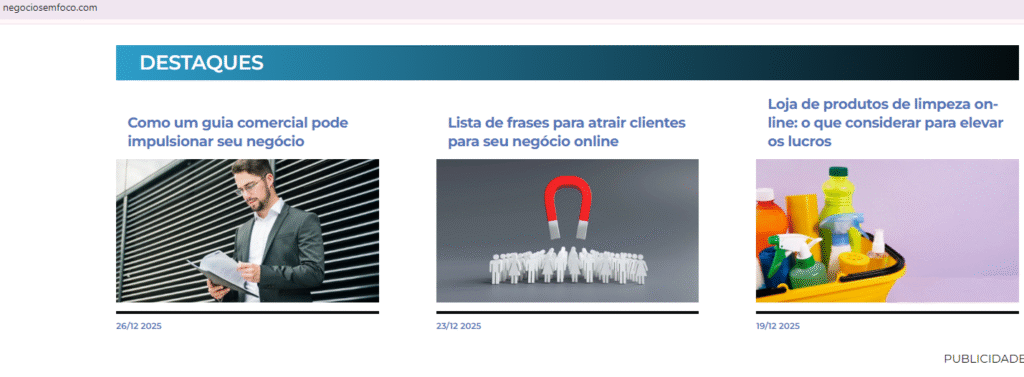
7. Evaluate success with qualitative metrics
After 30 to 60 days, evaluate:
- Do people cite your content in conversations?
- Do leads mention specific articles?
- Does the reader return without being impacted by ads?
If the answer is “yes,” your segmentation is working—even with lower volume.
Final rule of application
Before clicking “publish,” mentally answer: “Would this text be missed if it ceased to exist?” If the answer is no, the problem is not SEO or AI. It is the lack of context or identity.