

Digital marketing has changed and is entering a new era. To avoid being affected by these shifts, learn more about first-party data and prepare your strategy for a cookieless future.
You have probably noticed a significant difference when browsing the web. Today, it is very common to be asked to authorize the collection of third-party cookies, whether on a website page or directly in your browser.
This change reflects public policies and shifts in consumer behavior regarding privacy.
A 2024 survey conducted by PwC found that 90% of Brazilians say data protection is essential for a company to earn their trust. In addition, 86% of respondents require guarantees that their personal information will not be shared.
This overall landscape shows that the era of segmenting, measuring, and personalizing campaigns based on external data is over. Now, the entire data ecosystem must be reconfigured, building a foundation rooted in consent.
And this shift affects not only data practices, but also optimization strategies, content curation, and all organic traffic efforts. Without cookies, search becomes the most reliable source for understanding user intent. In this context, first-party data becomes the key piece.
First-Party Data as the new digital strategy
In an era of strengthened privacy and the absence of cookies, primary data has become the infrastructure that supports marketing strategies.
These types of data are collected directly from the audience:
- Through on-site interactions, with consent;
- Via email registrations;
- From CRM data;
- Through purchase history;
- From app usage.
They are valuable pieces of information related to the behavior and interests of consumers or potential customers. Their value lies in the quality and relevance of the information.
Businesses no longer need to predict behavior based on generic datasets. Instead, they have up-to-date data reflecting the real motivations behind user searches.
What makes first-party data important for SEO?
In addition to being reliable and accurate, these data respect privacy because users must be informed about their collection, whether through permission requests or site policies.
When applied to SEO strategies, they bring benefits such as:
- Content personalization: user interaction allows for the creation of content that truly generates impact;
- Greater organic visibility: first-party data help identify real phrases and keywords used by users;
- Improved user experience: with data about the customer journey, it is possible to optimize navigation, site speed, and content flow;
- Privacy prioritization: basing SEO on ethically obtained data increases compliance and consumer trust.
Integrating First-Party Data into your SEO strategy
In a cookieless scenario, SEO is no longer just about rankings; it becomes an audience intelligence strategy. Integrating primary data with organic search requires four main tactics:
1. Intelligent data collection
Adopt strategies that encourage users to identify themselves naturally. Keep in mind that this technique is based on a value exchange: the user provides information and receives high-quality content in return.
To implement this, invest in questionnaires, surveys, newsletters, exclusive content, live sessions, webinars, tutorials, spreadsheets, infographics, and more.
See an example of how to do this:

Above is an infographic created by our team that collects this information. For instance, to download your e-book, you may request the user’s contact email.
2. Create content based on real data collection
Analyzing everything obtained through first-party data generates ideas for new content. Internal searches, category clicks, and time on page provide more information than one might expect.
If a user is exploring specific tabs such as “how to choose,” and your business is a jewelry store selling engagement rings, specific content on that topic—or on ways to find out the bride-to-be’s ring size—becomes highly relevant to your target audience.
Below is a piece of content generated by our team based on user intent on one of our clients’ portals:

Image: Smartia
In addition to answering the question, it is also well-structured content, which increases time on page. Many readers were searching for information about companies offering consortium financing. We leveraged this demand and created a ranking of the best consortium options in Brazil.
3. Segmentation and experience personalization
Undoubtedly, this is the most strategic aspect of using first-party data in content creation.
Based on primary data, it is possible to adapt headlines, CTAs, and the content itself. All this personalization must align with the customer’s or reader’s journey.
Individualizing the experience generates greater relevance and user loyalty without impacting privacy—an essential factor in the cookieless era.
4. Integration between tools
For content optimization to produce positive results, it is essential to integrate SEO, CRM, and Analytics.
Tools such as Google Analytics 4 (GA4), server-side tracking, and Customer Data Platforms allow you to visualize the impact of organic traffic on real business metrics, such as customer acquisition cost and customer lifetime value.
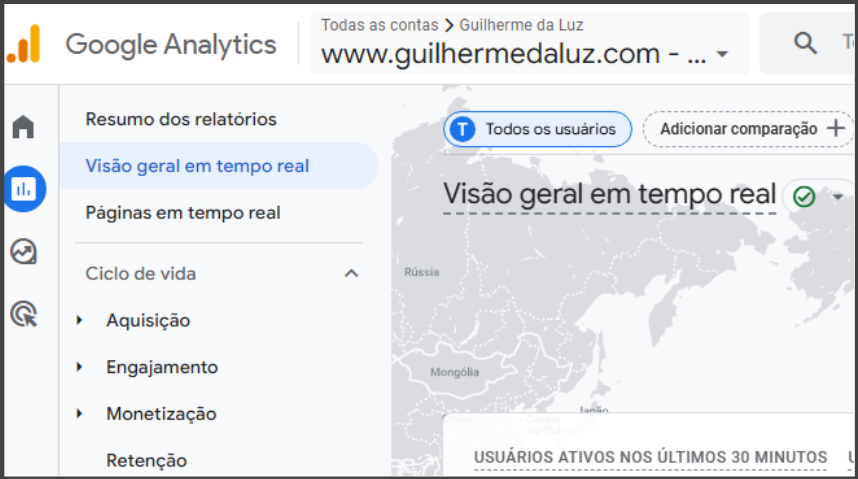
We use this integration and are able to obtain relevant insights to consistently deliver what our readers are looking for. Here is an example of how much information you can gather in Google Analytics:
So, can you see how worthwhile this integration is?
Long-Term Success, Even Without Cookies
Without a doubt, the secret to success in the cookieless era is building an internal database with planning, intention, and, above all, consent.
Therefore, it is important to consolidate data from multiple sources into a single location, such as a Customer Data Platform. This strategy creates a holistic and much deeper view of the collected information.
With consolidated data, build dynamic dashboards using materials tracked from your own server. This will lead to more accurate decisions and reduce heavy dependence on external data.
Beyond being cookieless, this era could also be called the era of transparency. Every user needs to know what data is collected and how. Establish clear privacy policies and implement simple mechanisms for granting or refusing consent.
Operating without cookies requires marketers to design flows, validate consent, and transform information into competitive advantage.
In this new scenario, trust is the new marketing capital, and first-party data is the most valuable asset. And your website—are you prepared for the cookieless future?