

AAIO refers to agents capable of making decisions, performing tasks, and interacting without human intervention. Learn how to prepare your website for this new digital era.
The way search engines understand websites has changed — and it continues to evolve rapidly.
Now, as Artificial Intelligences move beyond being mere support tools to becoming autonomous digital agents, digital optimization gains a new discipline: AAIO.
If SEO prepared content for search engines to rank on Google, AAIO adapts websites and content to the way AI agents consume, interpret, and recommend information.
Discover everything about this subject and learn how to prepare your website for this new ecosystem.
Why digital agents matter in the new era of marketing
If you’re wondering what AI agents are, it’s important to clarify that they’re not simple chatbots.
They’re advanced systems such as GPT-5, Claude, and Gemini, already integrated into corporate solutions. These tools are capable of:
- Interpreting context in natural language;
- Comparing solutions and providers based on data available online;
- Making decisions about product or service recommendations;
- Performing tasks like booking trips, creating shopping lists, hiring services, or writing reports.
Although this may sound futuristic, it’s already a reality in some industries. Gartner estimates that by 2028, 15% of everyday work decisions will be made by autonomous agents, and 33% of corporate applications will integrate these agents by then.
In the near future, a logistics director might ask their corporate AI copilot to “list the top three transportation companies in São Paulo specializing in perishable goods.”
If your company’s website isn’t prepared to be understood by these agents, it will become invisible, even if your page ranks highly on Google.
In this sense, brand visibility will no longer depend solely on attracting human users, but also on being understood and prioritized by digital agents that make decisions on people’s behalf.
The relationship between AAIO, SEO, AEO, and GEO
Like everything else in the world of digital marketing, AAIO is an evolution of how search works.
It doesn’t mean that existing strategies like SEO, AEO, and GEO will be replaced.
In fact, they will be expanded and refined.
With AI agents, the logic changes:
- The response may no longer be a list of links. The agent can deliver a direct recommendation, leaving no room for users to visit additional pages;
- Context matters more than keywords. Semantics, clarity of structured data, and source reliability carry more weight;
- Agents consume APIs, data, and integrations. If your website doesn’t provide clear, structured, and connectable information, the agent may simply ignore it.
In essence, while SEO and AEO help people find your website and GEO increases generative AI citations, AAIO is designed to support the agents that interact with your site and perform user tasks.
This shift demands a complete rethink of digital marketing strategies.
The challenge is no longer just to rank or be found – it’s to be readable, actionable, and trustworthy for autonomous AIs.
The pillars of Agentic AI Optimization (AAIO)
AAIO can be summarized in four main pillars:
1. Semantic clarity and data structuring
Digital agents rely heavily on structured data to interpret and compare information. This includes:
- Using structured data (such as schema markup) to clearly describe products, prices, and reviews;
- Writing clear, jargon-free text that enhances comprehension and removes ambiguity;
- Maintaining a hierarchical content organization, with well-defined headings.
2. Accessibility via APIs and integrations

If AI can access your data directly and securely, it will be much easier for it to recommend your brand. This means:
- Making public or well-documented APIs available;
- Simplifying access by keeping APIs and catalogs updated, and ensuring data is presented in machine-readable formats;
- Guaranteeing that critical information — such as pricing, availability, or contact details — is always accessible and consistent.
3. Authority and trustworthiness
AI agent tools are being trained to evaluate credibility.
Websites that demonstrate authority are more likely to be prioritized.
This involves:
- Displaying verifiable social proof — such as reviews, testimonials, and success stories;
- Ensuring website security through HTTPS, LGPD compliance, and clear privacy policies;
- Producing content that references reliable and traceable sources.
4. Task orientation
Unlike humans, an AI agent only performs a specific task.
Therefore, the website must facilitate its actions with short, objective, and clearly defined sessions:
- CTA buttons that are clear and connected to APIs;
- Product or service pages with complete information in structured format;
- Reduced access barriers — fewer clicks and simplified forms.
How to start implementing AAIO on your website
In essence, AAIO aims to prepare your pages to be chosen by digital agents.
To do that, focus on:
- Structured data audits: use tools like Google’s Rich Results Test to check whether your pages have relevant schemas implemented. If not, start with the basics: organization, product, FAQ, and review schemas;
- Content clarity: review institutional and product texts.
Ask yourself: if an AI agent read this paragraph, would it have enough clarity to recommend my company? - Accessibility infrastructure: assess whether you can open APIs that expose catalogs, availability, or FAQs. The easier it is for an agent to consume your data, the better;
- Authority reinforcement: invest in leadership content such as technical articles and case studies. Also, strengthen your digital reputation through citations, quality backlinks, and presence in trusted directories;
- Task-oriented design: test the conversion journey from an agent’s perspective.
If it had to “buy a product” or “book a meeting” automatically, could it do so on your site?
Overall, it is crucial to invest in consistent and machine-readable interfaces, ensuring that both agents and human users can understand the content without ambiguity.
Reasons to start today
Adopting AAIO is entirely strategic.
Those who adapt early to this new era will gain competitive advantages such as:
- Greater visibility in recommendations made by AI agents;
- Increase in indirect conversions, since many decisions will soon be mediated by digital agents;
- Future relevance building, preparing your brand for a scenario in which human interactions will increasingly be filtered by AIs.
Agentic AI Optimization (AAIO) is more than a trend — it’s an inevitable movement driven by the rise of artificial intelligence.
How to Apply SEO While Respecting AAIO
As you saw above, the term AAIO (Answer, Action, Information, Offer) is a practical evolution of modern SEO. After all, it integrates user intent and the complete search journey into a single, seamless framework.
Therefore, applying SEO within the AAIO model means structuring content to respond, engage, and convert, all while maintaining a unified experience.
Let’s break it down and see how we apply it in practice.
1. Understand what AAIO means in the context of SEO
Since the AAIO model replaces the old, purely informational view of SEO (centered only on keywords), it’s crucial to study it thoroughly. In general, we know that AAIO divides content into four key pillars:
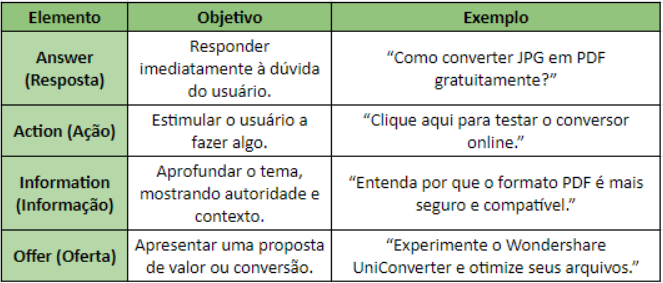
- Answer — respond directly to the user’s question or intent;
- Action — guide them toward a practical next step;
- Information — provide deeper context, data, or comparisons;
- Offer — present a clear solution, plan, or product.
Thus, applying well-defined SEO strategies within this framework is the key to success.
2. Keyword Research Based on Intent
We go beyond simply chasing search volume — it’s crucial to understand search intent so that both SEO and AAIO principles are met. In general, focus on:
- Questions: target direct query keywords (“how to,” “what is,” “why”).
- Action: focus on transactional terms (“test,” “download,” “try”).
- Information: invest in educational keywords (“advantages,” “best format,” “comparison”).
- Offer: use conversion-oriented terms (“buy,” “free plan,” “subscription”).
We rely on tools such as Semrush, Ahrefs, and others — they make mapping these intents straightforward and efficient.
3. Structure the Content Following the AAIO Flow
We organize the text according to the reader’s journey, ensuring clarity and natural engagement:
-
Introduction = Answer
Respond directly to the main question right in the introduction. Show the user that they’ve come to the right place.
-
Early Body = Action
Provide something practical: a button, a tool, a link, or a quick mini-tutorial. This keeps the content easy to read and enhances User Experience (UX).
-
Development = Information
Dive deeper — bring data, examples, differentiators, and comparisons. Invest in visuals like infographics and short videos to make the content dynamic.
-
Conclusion = Offer
End with a clear and coherent offer that aligns perfectly with the user’s search intent.
4. Technical Optimization Focused on UX
AAIO doesn’t work without an optimized User Experience (UX). Therefore:
- Use headings (H1, H2, H3) containing keywords and questions.
- Insert internal links (to provide depth) and clear CTAs (to drive action).
- Keep the content scannable: short paragraphs, lists, and highlighted elements.
- Apply structured data (FAQ, how-to, product) to reinforce the “Answer” pillar.
- Ensure speed, accessibility, and overall readability.
In general, here’s how we implement this with a practical and concise example:
For a piece created by our writers on the topic “How to convert JPG to PDF”:
- Answer: “To keep these files secure and consistent, converting JPG to PDF is a practical and quick solution, as it ensures the document stays in a universal, lighter, and easier-to-share format.”
Below is an example of a post we created for our client Smallpdf:
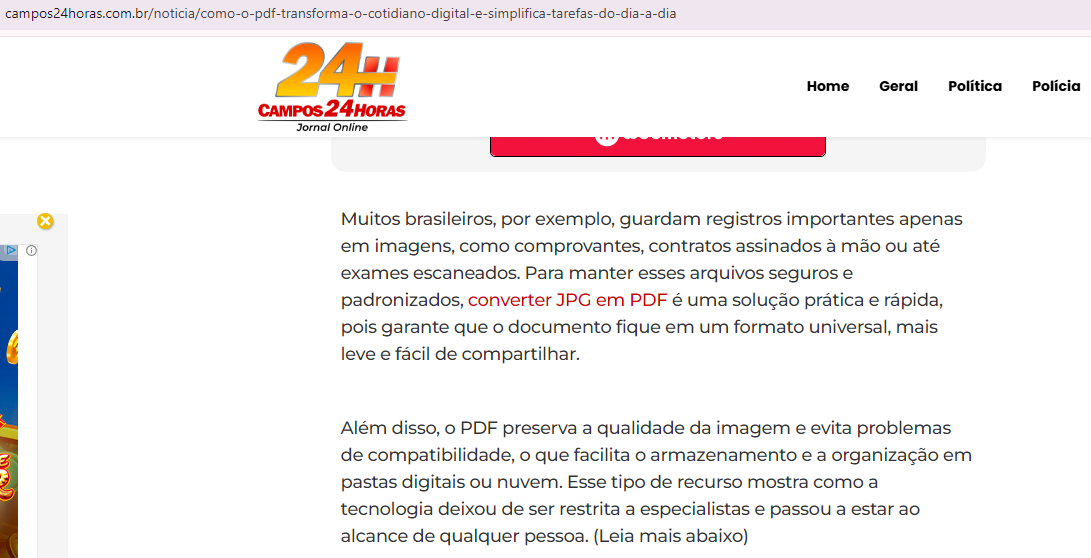
Image: Campos24horas
- Action: “Click here to upload your images and generate the PDF.”
- Information: “Recoverit is an advanced solution that simplifies the process of recovering deleted files on Mac.”
Here’s another example of how we approach it:
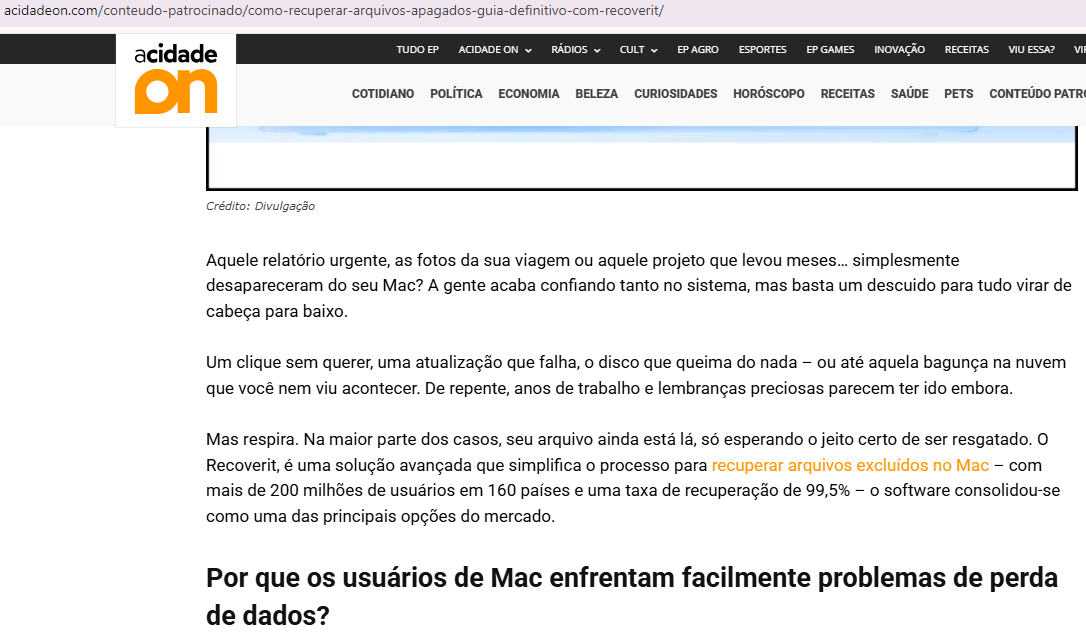
Above is a content post created by our team for Wondershare Recoverit, published on the ACidadeOn portal. Notice how we naturally added useful information for the reader, explaining how Recoverit can help them recover deleted files on Mac, in a practical, clear, and engaging way.
- Offer: “Download Wondershare UniConverter and get unlimited conversions.”
In other words, create an engaging CTA that encourages immediate action.
So, are you ready to compete in the new AAIO digital ecosystem? Start today by reviewing your structured data and assessing whether your company is already prepared to be found and recommended by AI agents.
If you need help getting your website ready for digital agents, count on our team. Get in touch with our SEO specialists and learn how to fully implement Agentic AI Optimization (AAIO) on your website.