
With SGE impacting thirty percent of search queries, organic traffic is expanding far beyond Google. GEO, curation, and social SEO are becoming the primary answers for modern growth.
What used to feel like a certainty, optimizing purely for Google if you wanted traffic, has turned into a strategic gamble. While Google still dominates the market, the search ecosystem is rapidly fragmenting.
In this evolving environment, content curation is shifting from a basic publishing routine into a high-value strategic filter. In an increasingly noisy online landscape, curated insight helps teams maintain domain relevance and capture audience interest as discovery habits change.
Data from BrightEdge shows that Search Generative Experience (SGE) already powers 30 percent of search queries in the US, expanding by 2 percent every month. Projections suggest that over 50 percent of queries will be impacted soon, putting 40 billion dollars in ad spend at stake. Search is transforming into a direct conversation, and that conversation often starts and finishes right on the search engine results page (SERP).
Average click through rates (CTR) drop by 25 percent when AI Overviews appear, according to Semrush data. In e-commerce, category pages suffer CTR drops of up to 41 percent. Paid and organic listings are both losing prime real estate above the fold. The old playbook of ranking at position one to capture instant clicks is fading. Where does search volume go when users stop clicking blue links?
The answer lies across two main frontiers.
The new frontier for organic traffic: GEO, social SEO, and the era of citation
The first frontier focuses on optimizing for new discovery engines through Generative Engine Optimization (GEO). While traditional SEO aimed at ranking for search algorithms, GEO focuses on earning citations directly within generative AI responses.
The global Generative Engine Optimization market currently generates 1.09 billion dollars and is projected to reach 32.92 billion dollars by 2036, recording a compound annual growth rate (CAGR) of 40.6 percent. This rate of expansion substantially outperforms the growth trajectory of several established enterprise software categories.
Companies adopting this approach are seeing measurable returns, with 78 percent of organizations investing in GEO reporting positive ROI. Yet GEO is not the only move on the board, as search discovery is rapidly migrating toward social platforms.
Studies show that 73 percent of purchasing decisions begin on platforms like TikTok, Amazon, ChatGPT, and Reddit. This is where YouTube SEO and Instagram SEO enter the picture. Search behavior data is clear: 1 in 3 consumers now skips Google entirely and starts their research directly on social channels.
For Gen Z, that figure exceeds 50 percent. Furthermore, Google already indexes public content from Instagram and TikTok, creating a compounding effect where Social SEO also feeds your visibility on the traditional search engine.
Strategic curation: the competitive advantage in the AI era
If click rates are dropping and discovery is fragmenting, how do digital publications stay ahead? The solution involves leaning back into foundational quality through strategic content curation. Rather than simply compiling external links, strategic curation focuses on data driven analysis and domain authority.
As generative AI answer engines mature, visibility depends on becoming a trusted source cited within AI answers. Generative engines constantly crawl for authoritative, up to date material backed by strong E-E-A-T signals.
Brands that consistently refine, update, and publish strategic content build significantly higher organic visibility compared to those with low content output. Integrating technical markup like FAQ and Speakable schema plays an essential role in helping AI platforms identify and cite your content.
This shift makes holistic content strategy a core tactical requirement. Publishing for the sake of output is no longer viable. Teams must map the exact questions their audience asks, spot gaps where AI answers fall short, and build deep resources that generative models naturally cite.
Thin product pages containing a few hundred words can no longer drive meaningful organic growth. Superficial content has become a primary bottleneck for digital strategy.
A connected search ecosystem
The modern buyer journey is no longer a linear funnel. It functions like an interconnected web. A user might discover a product on TikTok, research its specific capabilities inside ChatGPT (which cites your detailed guide), check user feedback on YouTube, and ultimately complete the purchase directly on your site without ever typing a keyword into a standard search box.
Marketers who rely exclusively on legacy tactics, focusing solely on high volume head terms and basic link acquisition, will see organic traffic decline. Conversely, teams that embrace modern search complexity by optimizing for generative search engines, investing in GEO, and mastering video SEO will build scalable foundations for future growth.
The future of organic reach does not belong to a single platform. It lives wherever your audience asks questions. The most effective way to stay discoverable is to produce exceptional, highly relevant content.
Strategic recommendations to elevate organic reach
1. Shift focus away from raw keyword volume
Traditional SEO strategies relied heavily on identifying high volume terms, writing standard 1500 word posts, and repeating keywords to fill publishing schedules.
That approach often produces commoditized answers for simple queries like “What is digital marketing?” because AI engines answer basic definitions instantly. Contrast that query with: “How have search generative experiences impacted organic conversion rates for enterprise sites?”
That refined topic leaves room for:
- Strategic analysis
- Regional and industry context
- Direct team experience
- Proprietary data points
- Expert viewpoints
- Real world implementation examples
In-depth pieces built around contextual insight generate higher click rates, stronger natural backlinks, and more frequent AI citations.
2. Create content that AI cannot generate on its own
AI models excel at rephrasing existing web knowledge, but they cannot replicate original human experience. High performing blogs prioritize unique insights such as:
- Hands on platform testing
- Detailed case studies
- Professional lessons learned
- Documented campaign results
- Direct performance comparisons
For example, compare a generic guide titled “How to improve website SEO” with a case study titled “What happened after we restructured 50 low performing pages on our platform.” The second example brings original, real world experience that AI crawlers cannot synthesize from existing articles.
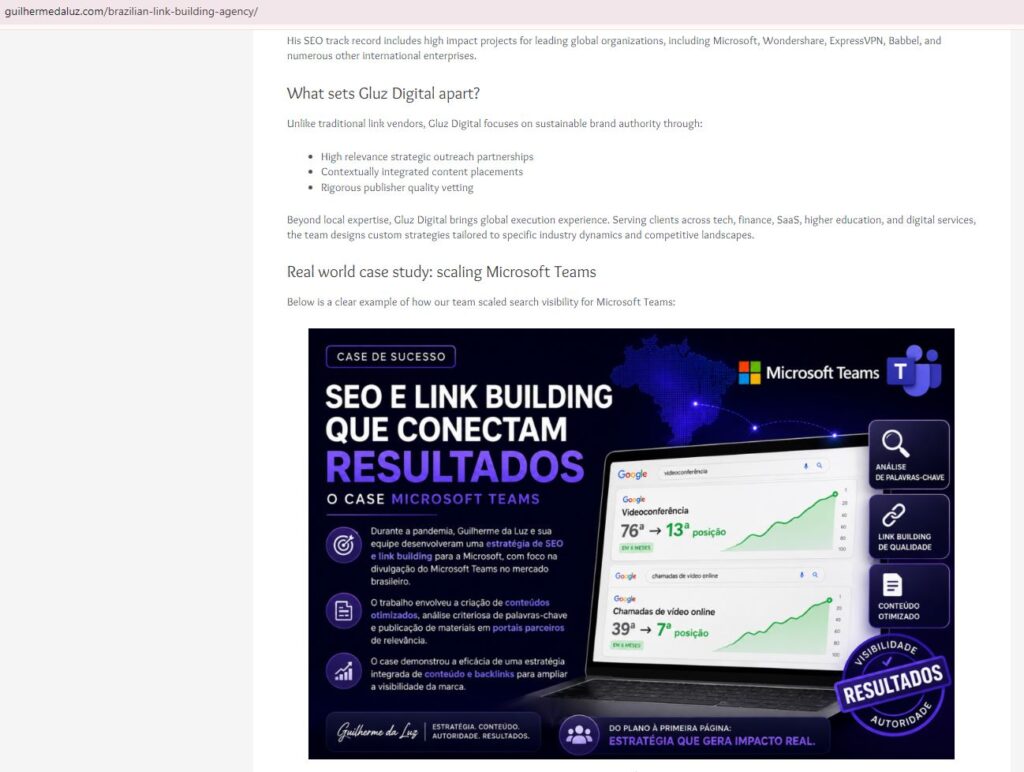
As you can see in the image above, I included in the content the experiences my team gained while working with Microsoft Teams. In other words, this success story is based on real experiences and real data.
3. Target high click intent topics
Not every query yields website visits. Simple informational queries are increasingly answered directly inside search engine result pages. Successful planning requires dividing target topics by click probability:
Low click probability topics:
- Basic definitions
- Simple factual queries
- General terminology overviews
High click probability topics:
- Tool and software comparisons
- Deep dive product reviews
- Complex technical tutorials
- Custom strategy breakdowns
- Niche problem solving guides
- Real world case studies
Querying “Which password manager is best for a remote team of 50 employees?” requires analysis and context, making users far more likely to click through to an expert article than asking “What is a password manager?”
4. Build link worthy and citation ready assets
Focus on why another platform, editor, or AI system would actively cite your work. Reference worthy content typically includes:
- Original industry survey data
- Proprietary benchmarks and statistics
- Comparative performance tests
- Clear frameworks and methodologies
- Practical reference tables
An article titled “10 SEO trends for 2026” competes with thousands of similar posts. However, a data study titled “Analyzing 100 enterprise sites: how AI Overviews impacted organic CTR” creates immediate opportunities for earned backlinks, social shares, and authoritative citations.
5. Take clear editorial positions
Mass produced AI content often sounds neutral and repetitive, relying on generic transition phrases without offering a distinct stance. Strong digital publications express clear, well reasoned perspectives.
Instead of publishing generic headlines like “AI is changing digital marketing,” adopt clear editorial angles like “Organic reach is not dying, but volume based publishing is.” Distinct viewpoints trigger user curiosity and build brand identity across competitive industries like technology, finance, and marketing.
6. Design content that prompts follow up searches
Great content satisfies an initial query while revealing logical next steps. A reader researching keyword discovery methods will naturally need to understand search intent analysis, keyword difficulty metrics, and content clustering.
To guide visitors through a complete learning path, build clear site journeys with:
- Contextual internal links
- Related topic hubs
- Actionable next steps
The goal is to transition the user journey from a single page visit into an engaging, multi page experience that leads directly to conversion.
A practical strategy for sustainable organic traffic
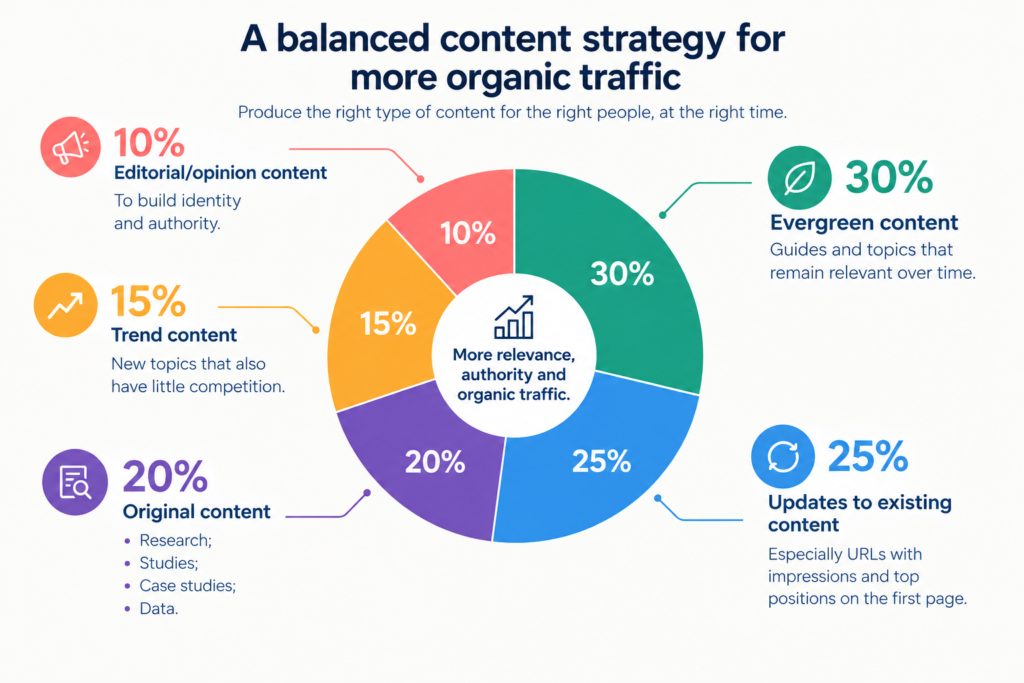
I would use a breakdown similar to this one:
The fundamental shift
The core strategic question has changed. Instead of asking “Which keyword should we target next?”, ask “What unique insight can we provide that automated search engines cannot instantly answer?”
Generic information is everywhere. Original analysis, verified data, authentic experience, and clear editorial context are what build lasting digital authority.
Key priorities for organic growth
To expand your organic reach, move away from surface level content and focus on irreplaceable resources. Prioritize:
- Authenticated real world experience
- Proprietary research and data
- High click intent queries
- Regular content refreshes
- Deep topical authority
- Detailed case studies and expert analysis
- Strategic internal linking architectures
The future of organic growth does not belong to platforms that publish the highest volume of pages. It belongs to organizations that deliver authentic value that AI answers cannot easily replicate.
With these principles in place, you have the strategy needed to capture top positions and citations across modern search engines and AI discovery platforms.