

Is your homepage losing direct visits while search impressions soar? Here is how AI Overviews are changing organic search and why authority hubs matter more than ever.
Impressions are rising, yet clicks are dropping. The infamous “crocodile jaw” pattern in Google Search Console is no longer a rare anomaly; it is the new baseline for organic performance. If your homepage is receiving less direct search traffic, rest assured that your SEO strategy is not suddenly broken. Instead, search behavior is undergoing a fundamental shift.
Our work at Content Marketing Consulting reveals a quiet reconfiguration of the organic search value chain. The underlying issue is not the quality of your content. Rather, it is how people consume information today: users now receive answers before they even finish forming their queries.
Generative AI platforms and AI Overviews interrupt traditional user journeys before they truly begin. Naturally, this reshapes the core purpose of your homepage.
For veteran SEO professionals, the core diagnostic remains clear: search intent still rules. However, that intent is increasingly satisfied directly within the search interface rather than through traditional blue links. The fundamental question driving our strategy at content marketing consulting is simple: if AI already answers the user on the SERP, what is the primary role of your website?
The end of the linear journey and the “crocodile” in Search Console
The classic SEO premise was straightforward: rank at the top for a relevant term, and organic traffic naturally follows. The journey was linear: search, click, visit. With AI Overviews, that predictable pathway has fundamentally shifted.
Industry research shows that the presence of AI-generated summaries correlates with a drop of up to 34.5% in click-through rates for top organic results. Data from Pew Research highlights an even sharper trend: when an AI summary appears, users click a traditional link only 8% of the time, compared to 15% when no summary is displayed.
Certain industries face even steeper shifts. In retail, for example, bounce rates from AI-driven visits are 27% lower, yet overall visit volume is significantly reduced.
This trend has earned a distinct name: the “crocodile” pattern in Google Search Console. Chart lines show impressions climbing while clicks steadily drop, creating an opening pair of jaws. This indicates that AI search models are discovering and synthesizing your content as a source, even as users gain the answers they need without visiting your site.
As a result, traditional tracking metrics like standalone pageviews are rapidly becoming outdated indicators of brand visibility.
AI models do not select websites the way human readers do. They prioritize information consistency, source consensus, and entity recognition. Despite common misconceptions, there is no magic meta tag or secret formula for guaranteed placement in AI Overviews.
The actual mechanism is far more sophisticated. Systems like Google Gemini execute query fan-out operations, breaking a single user prompt into multiple sub-queries to analyze diverse web sources simultaneously.
An analysis by Ahrefs revealed that 76% of citations in AI Overviews come from pages already ranking in the top 10 organic results, with the average source positioning in second place. Traditional SEO remains the primary gateway, but it is no longer the sole requirement.
Earning citations depends heavily on topical authority and clear entity recognition. When your brand and insights are cited across industry publications, forums, peer reviews, and expert analyses, AI systems recognize your domain as an authoritative source. These engines evaluate the broader web conversation surrounding your niche, not just the text on your server.
Rethinking information architecture for AI search
Given these shifts, the question is not whether the homepage still matters, but rather what purpose it serves today. The homepage is no longer merely a landing page; it has evolved into a central authority hub.
Updating your site architecture ensures search models can index, parse, and reference your expertise effortlessly:
- Direct response content structure: Clarity drives AI comprehension. Moving past lengthy introductory text allows key insights to sit at the forefront. Subheadings (H2, H3) should mirror the exact questions users ask, removing filler and delivering value immediately in the primary content layer.
- Citable assets over keyword-stuffed posts: Publishing standard keyword-optimized articles is no longer enough. Developing citable assets, such as proprietary research, original survey data, real-world case studies, and unique frameworks, adds fresh information to the industry dialogue. Strategic curation transforms simple aggregation into high-value synthesis.
- Consistent entity representation: AI systems require unambiguous brand identity data. Discrepancies between your About Us page, LinkedIn profile, and Google Business Profile create entity resolution confusion. Maintaining uniform brand mentions across all channels builds a strong, distinct entity that AI algorithms confidently reference.
The new landscape of organic visibility
The rise of AI in search does not mark the end of SEO; it signals its maturation. The core objective has shifted from capturing position rankings to establishing undeniable relevance. Your homepage remains vital, serving as the nucleus of a broader digital ecosystem.
It acts as the anchor for your brand entity while your broader content library delivers direct, complete, and highly citable answers.
Modern SEO strategies require comprehensive content audits that extend far beyond keyword volume metrics. Mapping the exact information gaps AI engines attempt to resolve ensures your content addresses search intent while standing out as the preferred source for algorithmic synthesis. Today, true search visibility means becoming the answer itself, not just a link on a page.
An effective homepage requires far more than a clear value proposition, professional design, and basic social proof. Converting curious visitors into engaged clients or long-term followers relies on a structured, high-performing layout:
- Headline: a concise, compelling statement summarizing the primary transformation you deliver. Clear, direct language combined with your primary keyword works best.
- About section: a focused overview highlighting your professional background, key milestones, and core specialization. Connecting your story directly to your audience’s challenges demonstrates expertise without overwhelming the reader.
- Social proof: client testimonials, recognizable partner logos, and media features build immediate credibility.
- Services or solutions: clearly organized visual blocks detailing core offerings, such as consulting, courses, mentorship, or advisory services.
- Calls to Action (CTAs): high-visibility buttons designed around clear actions, such as “Speak with our team,” “Book a strategy call,” or “Download the free guide.”
- Blog or Content: if you produce high-quality content (articles or videos), highlight your best pieces to demonstrate your practical knowledge. Organize them into categories on your website.
Consider an agency homepage as a practical example. Because an agency relies on clear strategy, proven outcomes, and high-value communication, its own website must serve as its strongest case study.
Key homepage priorities include:
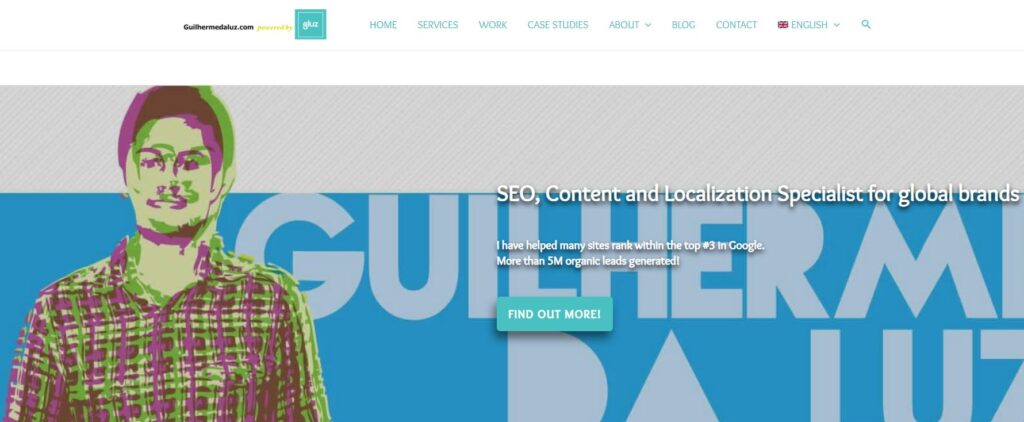
1. High-impact headline
Focus directly on the primary business outcome your clients desire, paired with an action-oriented call to action:
- “Expand organic reach and convert readers into loyal long term clients.”
2. Explanatory subheadline
State your core capabilities clearly without unnecessary jargon:
- “Specialized agency focused on SEO content strategy, corporate editorial growth, and full funnel lead nurturing.”
Take a look at my page as an example:
3. Primary CTA
Position a high-contrast conversion button prominently on the main screen:
- “Request a Free Audit” or “Speak with a Specialist.”
4. Social proof and performance metrics
- Client roster: display recognizable logos from current and past client partnerships.
- Verified results: highlight concrete performance figures in large, readable formats (e.g., “+3M organic visits generated,” “+500 top-ranked articles on Google,” “+40% increase in qualified leads”).
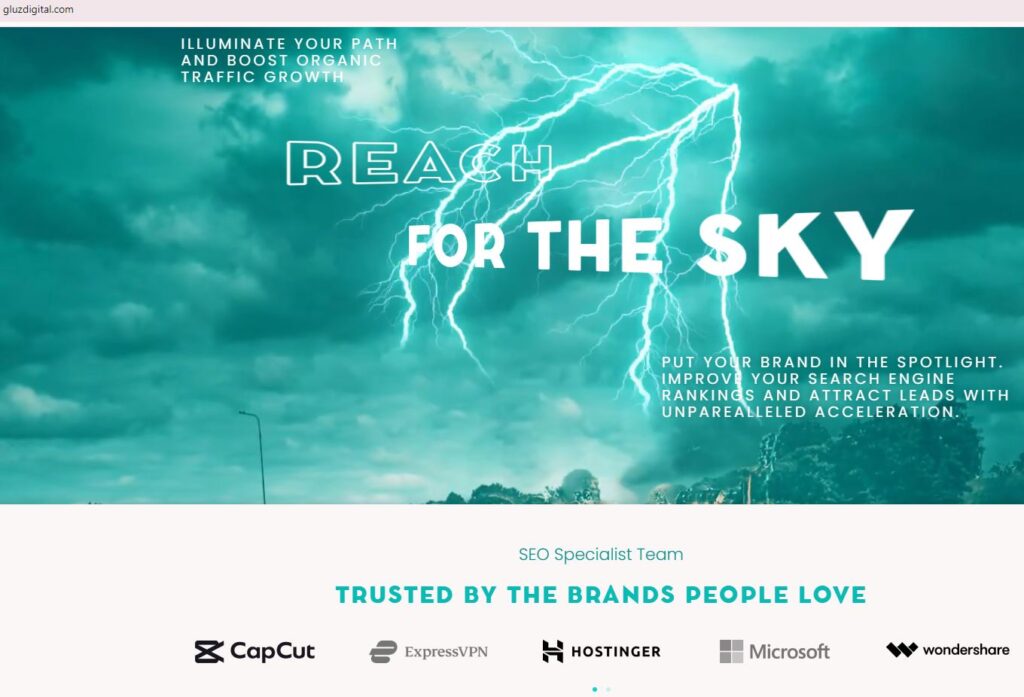
Image: Gluz Digital
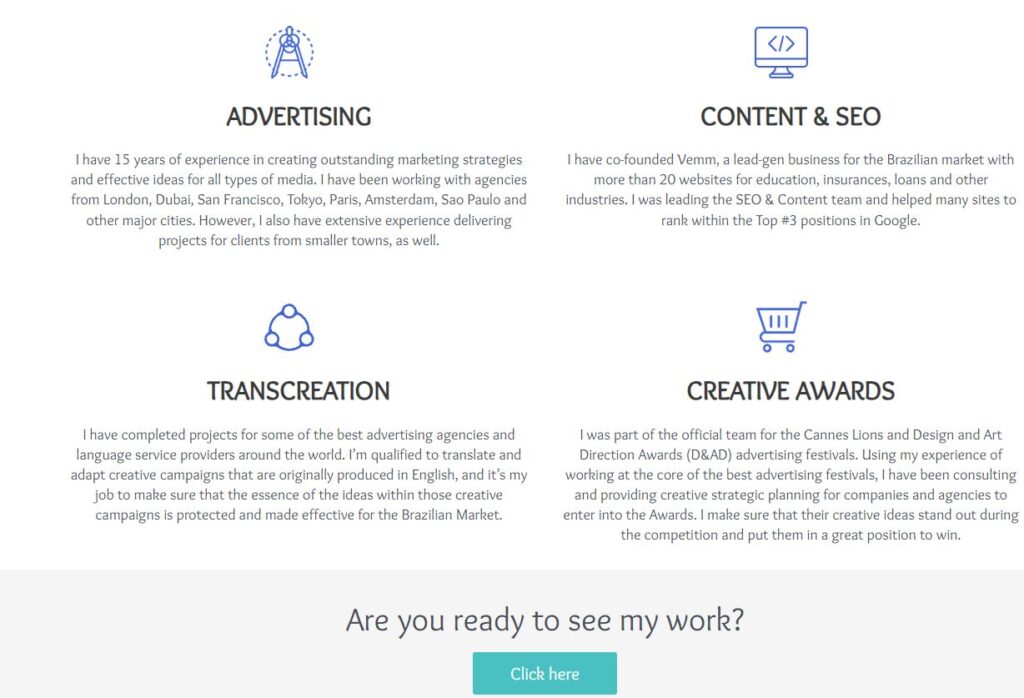
5. Core services overview
Organize core capabilities into clean, easily scannable segments:
- Strategy and Planning: Audience research, intent mapping, and content funnel development.
- Content Production: Search-optimized articles, editorial assets, and conversion copywriting.
- Lead Nurturing and Email Strategy: High-converting newsletters and automated email workflows.
- Performance Analysis and Optimization: Comprehensive technical SEO adjustments and transparent performance reporting.
Keep the information lighthearted; for example:
6. Client success stories and case studies
- Outline the initial client challenge, the strategic approach executed, and the final measurable results.
- Include brief client testimonials validating the impact of the partnership.
Organizing success stories into dedicated, clickable case study modules allows visitors to explore the specific challenges, strategy, and verified outcomes of featured client engagements.
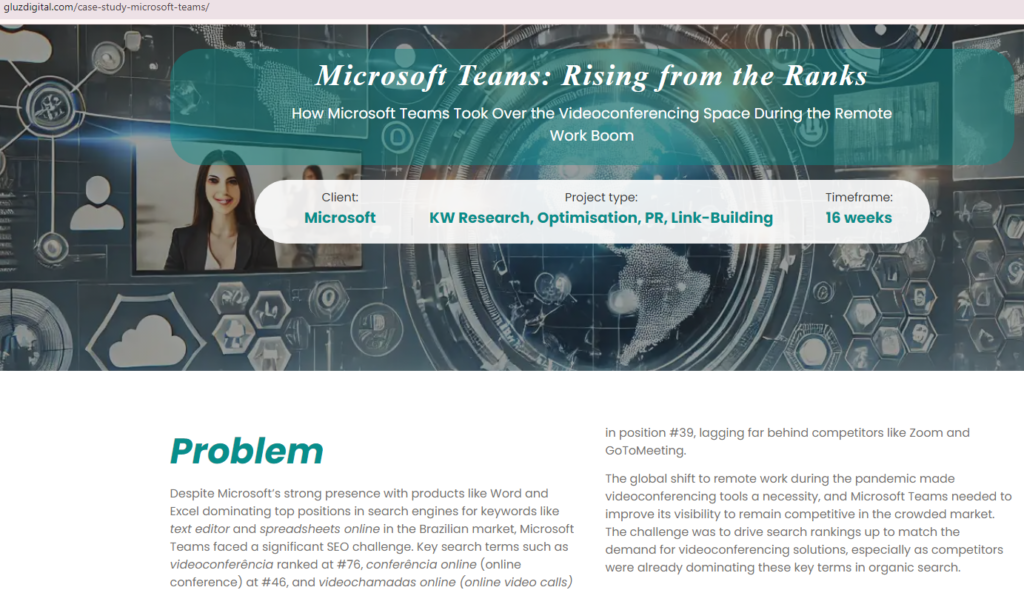
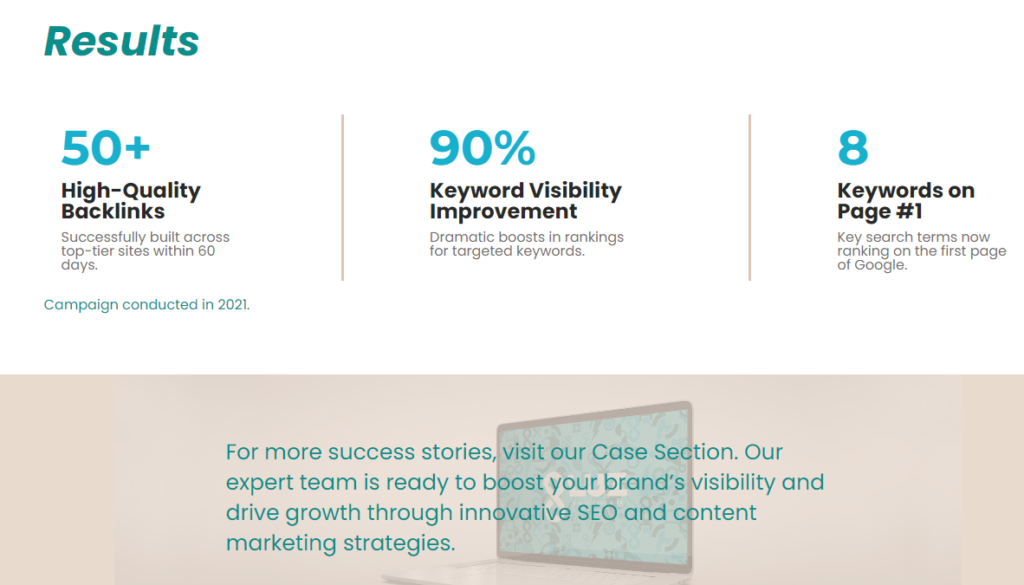
*See the details—including “problem,” “solution,” and “result”—of our work to boost the visibility of Microsoft Teams in search engines at Gluz Digital.
7. Featured agency content
- Demonstrate active domain mastery by showcasing your top three recent editorial pieces.
- Select headlines that address widespread client pain points (e.g., “How to accurately measure content marketing ROI”).
Throughout every section, integrating relevant industry terminology naturally reinforces topical focus without compromising readability.
So, does the homepage still matter? Understanding how user journeys evolve when AI guides search discovery is the key to staying competitive.
Reach out to our SEO strategy team today to discover how we can elevate your brand’s presence across search engines and AI platforms.
Would you like to review specific keyword placements or explore adjustments for a particular industry niche?